AI's New Mandate for Engineers: Ship What Users Actually Want
AI's New Mandate for Engineers: Ship What Users Actually Want
Here's a question that should make every engineering leader uncomfortable: How much of your team's code from the last sprint is actually being used?
Not deployed. Not shipped. Actually used.
Because here's what I'm seeing happen across companies adopting AI coding tools: Engineering productivity isn't just going up. The entire conversation about what engineers should be doing is getting turned on its head.
And it's exposing an uncomfortable truth that's been hiding in plain sight for years.
1. Velocity ≠ Value
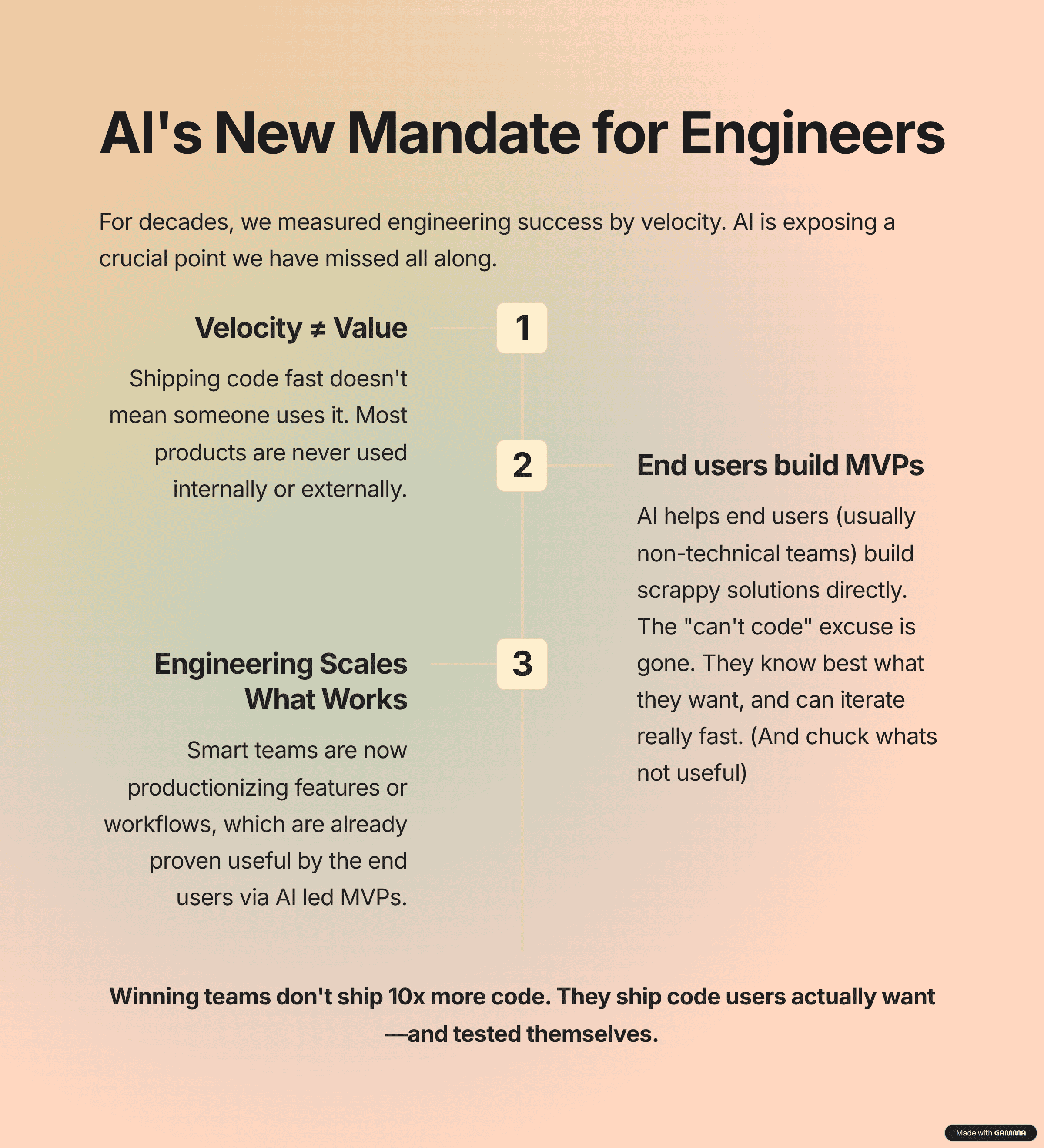
For decades, we measured engineering success by velocity. AI is exposing the truth we've missed: shipping code fast doesn't mean someone uses it.
Most products are never used internally or externally. Teams celebrate velocity while 40% of code goes untouched.
We optimized for shipping code. Not for shipping value.
Nobody questioned it because building was expensive. Two weeks of work? You shipped it. Sunk cost fallacy dressed up as "execution."
AI just killed that excuse.
2. Non-Engineers Build MVPs
AI helps end users (usually non-technical teams) build scrappy solutions directly.
The "can't code" excuse is gone. They know what they want, and can iterate fast. They chuck what's not useful.
What's happening now:
Customer success opens Cursor. Describes the workflow problem. AI builds a working prototype in 90 minutes. They test it with actual customers. Iterate based on real feedback.
Sales builds their own dashboards. Operations builds workflow automation. Finance creates analytical tools instead of writing requirements docs.
By the time Engineering sees it, the problem is solved—or proven not worth solving.
3. Engineering Scales What Works
Smart teams now productionize features or workflows already proven useful by end users via AI-led MVPs.
When prototyping costs hours instead of weeks, you validate hypotheses before wasting engineering time.
Old approach:
- Product: "Users want feature X"
- Engineering: 3 weeks of development
- Launch: 5% adoption, feature rot
New approach:
- Users build rough MVP with AI tools
- See if they actually use their own prototypes
- If yes, engineering builds production-grade version
- If no, you saved 3 weeks
Engineers focus on infrastructure, security, and scale—not building dashboards users could test themselves.
What This Actually Means (And Why Most Organizations Aren't Ready)
AI isn't just making coding faster. It's revealing that most engineering teams are optimized for shipping code, not shipping value.
When code becomes cheap, you're forced to confront an uncomfortable reality: Do you actually know what's worth building?
The organizations that win won't be the ones with the most engineers. They'll be the ones who:
Empower non-engineers to solve their own problems. Sales builds dashboards. Operations builds automation. Customer success builds workflow tools. If it proves valuable, Engineering productionizes it. If not, nobody wasted engineering time.
Kill half their roadmap. When you can build in hours, you realize how much of your backlog is low-value cruft. Smart teams are cutting planned features by 50% and focusing on the 3-4 things that actually matter.
Redefine roles, not just processes. Product Managers become hypothesis generators, not spec writers. Engineers focus on production infrastructure, security, and scale—not building dashboards sales could prototype themselves. The person closest to the problem owns the first version.
But this only works if you trust non-technical people to build. And most organizations don't.
That's the real bottleneck AI exposes.
What This Means For You
If you're an Engineering Leader: Stop optimizing for velocity. Start optimizing for impact. How fast can your organization go from "maybe users want this" to "data proves they do/don't"?
If you're a Product Manager: Your specs don't need to be perfect anymore. Empower teams to prototype their own solutions. Focus on identifying problems worth solving, not documenting solutions.
If you're in Sales/CS/Ops/Finance: You have leverage you've never had before. You can prototype solutions to your own problems. Stop waiting for engineering capacity. Start building.
If you're a Founder/CEO: Your engineering team can move 5x faster. But only if you restructure how decisions get made and who gets to build. If only engineers can prototype, you're wasting 90% of your AI leverage.
The Bottom Line
Winning teams don't ship 10x more code. They ship code users actually want—and already tested.
For years, we've hidden behind "engineering capacity" as the excuse. We measured velocity because measuring value was too hard.
AI is removing both excuses.
The teams that win are the ones who empower non-engineers to build, kill half their roadmap, and trust that the person closest to the problem knows what's worth building.
Originally inspired by [Siqi Chen's (Runway) observations on AI and software development]