What every CEO wants to ask their Marketing Teams? but seldom gets an answer to (1/n)
 CEOs looking for the real answer amidst marketing jargon
As the go-to guy for the CEOs and BU Heads for solving their growth queries, I have faced various questions which not only questioned my understanding of marketing but sometimes even the marketing team’s existence. I am not sure if I would use the same answer in every setting, as the context may be different. But most of the questions and answers listed here, have evolved over time (and are still changing). This Post will span over multiple short stories, so stay tuned.
Question 1 – What if we made our marketing budget zero?
– CEO, xyz
This one is my favorite, and this question usually pops up more often during downturns, and cost-cutting phases (ex: during covid 2020 years, the current recession times), but having an answer at all times is crucial for setting up a baseline for your growth marketing budgets pragmatically.
In order to answer this question effectively, you need 2 pieces of information
- What’s your cycle time
- If you acquire a user today, how exactly will they give business over say next 3 months, 6 months, or 1 year?
- What is your Channel mix
- Organic, Paid Marketing attributed
Lets look at both one by one
1. Business Cycle Time Explained
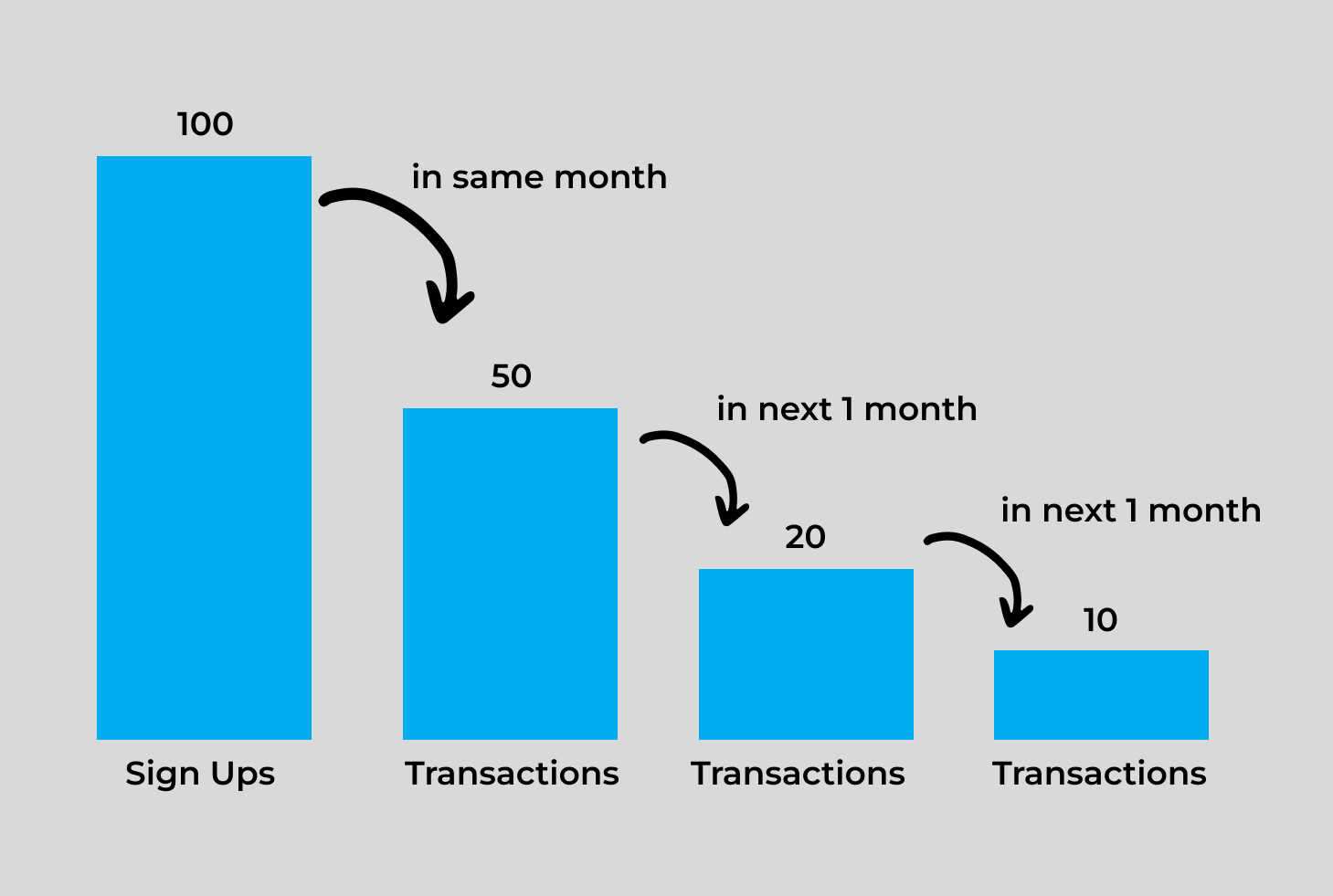 Business Cycle time explained
Typical ECommerce Example
- 100 users signup in a month
- 50 users transact in the same month
- 20 users in month 2
- and let us say 10 users transact every month from there onwards
Putting the same into a google sheet for modeling.
 Model for Transactions over time from Users acquired in a specific month. M0 stands for same month, while M1 means month + 1 and so on. Link to the Google Sheet for Modeling
Note: Highlighted in Orange – 110 in Jun is coming from respective previous month cohorts highlighted in Orange
2. Channel Mix of Acquisition Explained
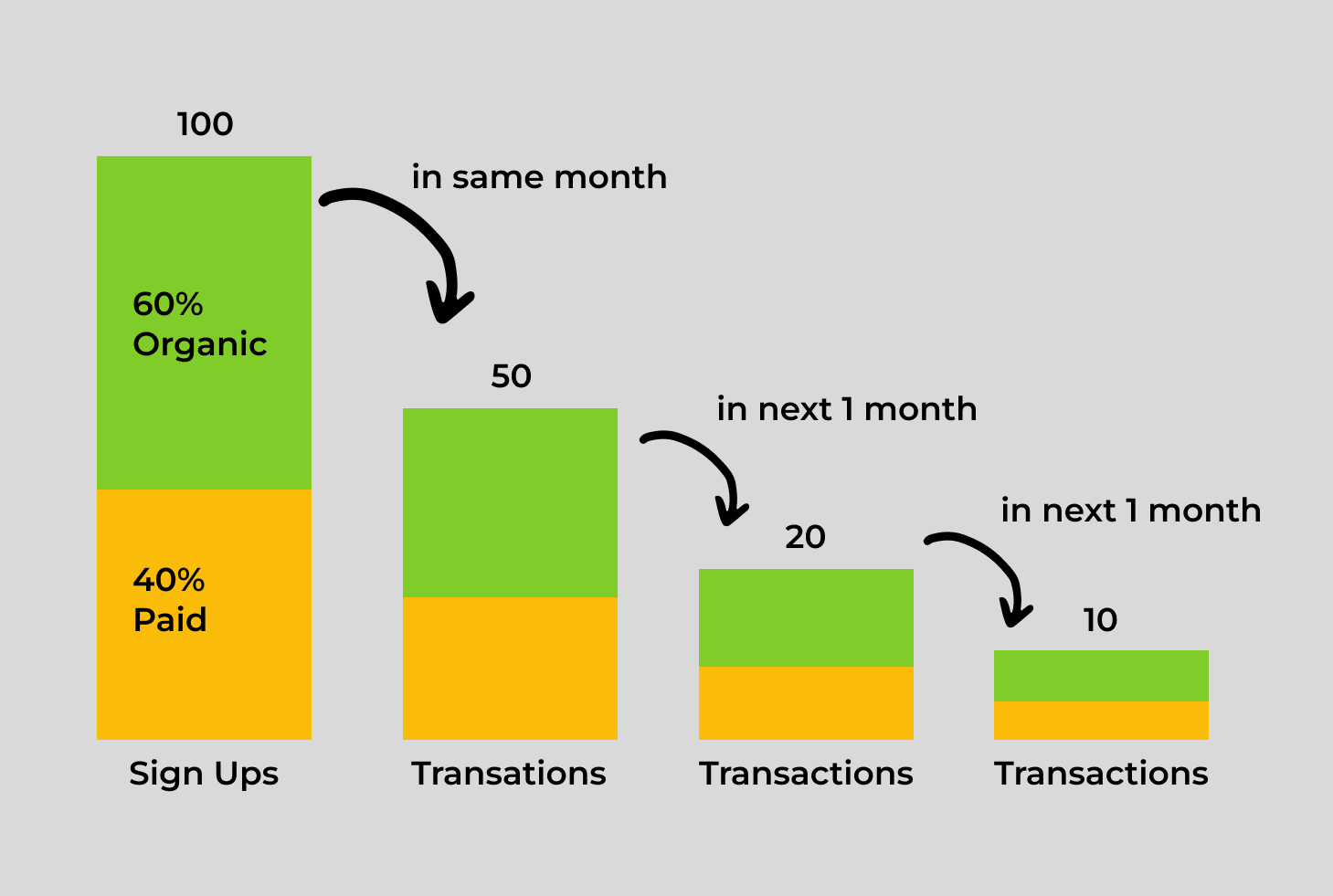 Business Cycle time Chart, overlayed with the Channel Mix (i.e. Paid and Organic Sources). The assumption here is that cycle time here stays the same across channels.
Assuming there are 2 main buckets
- All paid marketing is bucketed under the paid tag, and it contributes to 40% of the new users
- All free users are bucketed in organic, and the contribution to new users from organic is 60%
Putting the same into our model, again
 Scenario 1: As shown above, Stable State when both organic and paid channels are on. Splitting the Contribution from Paid and Organic Sources. Link to the Google Sheet for Modeling
Now lets turn off the Paid Channels from July and see what happens
 Scenario 2: Stable State when paid channels are switched off from Jul onwards. The new stable state slowly converges to (the rolling organic state + business from repeat usage of initial paid users) Link to the Google Sheet for Modeling
New Trendline emerges which is a convergence to the rolling organic state + repeat usage of previously acquired paid users
 The reduction due to switching off of certain channels has its full effect over a period of 3 months.
Thought Experiment for the reader : How much time it will take for the business to come back to the full scale when we switch the paid channels on back again?
Answer is 3 months again
In Conclusion – What if we made our marketing budget zero?
If we make the marketing budget zero, the business will converge to the business from the New and Repeat Organic users plus the Repeat Paid users. While the full impact on business will be visible only after the cycle time of the user (i.e. 3 months in this case). Therefore for very long cycles, switch-off and on decisions should be taken very carefully, and ideally monitored closely at cohort levels.
Other Considerations:
- If you have competition breathing down your neck, then the entire paid users cohort can go to competition meaning reduced market share for your company
- Organic in long run depends on a strong brand, hence not investing in the brand for a very long time, will start having an effect on organic traffic. This is again contextual to the business and the competitive landscape.